




From 6 to 11 September 2026, Prof. Michał Bilewicz from the University of Warsaw, one of Europe’s leading social psychologists in the study of prejudice, intergroup relations, collective memory, and conspiracy beliefs, visited the Institute for Research in Social Communication SAS as part of the SAS Mobility Visit programme. The multi-day programme combined the presentation of cutting-edge research to the broader academic community with intensive research, project-based, and applied collaboration.
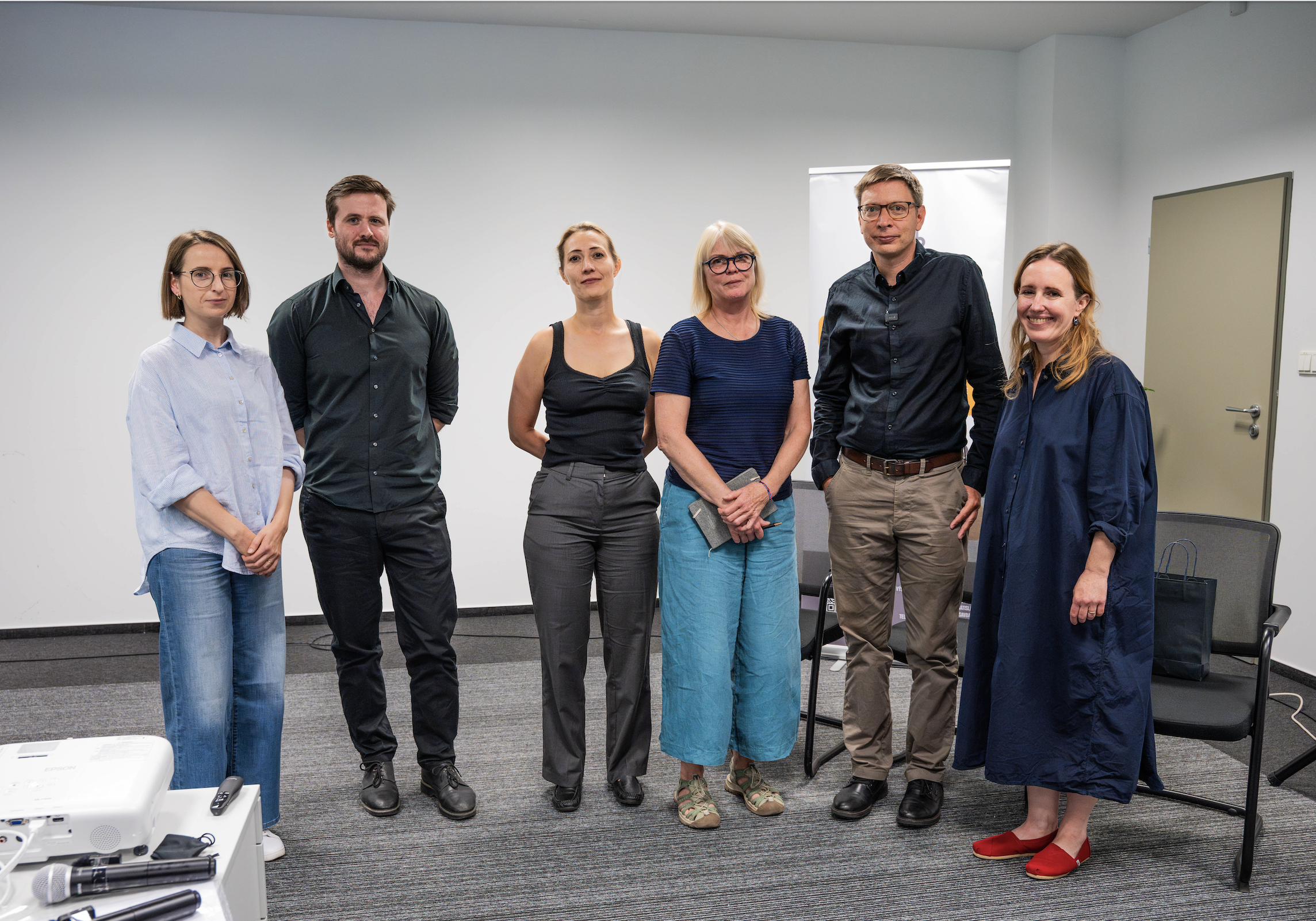
The main public event was the all-Academy lecture “Conspiracy Beliefs as Adaptations to Historical Trauma”, held on 7 September at the Institute of Materials and Machine Mechanics SAS. The lecture was opened with brief remarks by Zuzana Panczová, Vice-President of SAS for International Relations, and Barbara Lášticová, Director of the Institute for Research in Social Communication SAS. In his lecture, Prof. Bilewicz presented a social psychology perspective on conspiracy beliefs as possible psychological adaptations to experiences of war, violence, and prolonged uncertainty. Drawing on extensive research conducted primarily in Central Europe, a study of Ukrainian refugees in Poland, and experimental data, he showed how experiences of historical trauma and their intergenerational transmission may be associated with a sense of loss of control and, consequently, with conspiracy thinking. One of the key conclusions of the lecture was that conspiracy beliefs can also be understood as remnants of an originally adaptive belief system that, under conditions of genuine threat, helped people identify hostile intentions and hidden threats. At the same time, research suggests that inclusive interpretations of historical trauma, which do not portray one’s own country as the sole victim of suffering, may help mitigate these long-term consequences.
The lecture was followed by an interdisciplinary panel discussion featuring Magdalena Adamus and Patrícia Fogelová (both from the Centre of Social and Psychological Sciences SAS), Monika Vrzgulová (Institute of Ethnology and Social Anthropology SAS), and Dominik Želinský (Institute for Sociology SAS). The discussion connected social psychological insights with research on conspiracy theories, polarization, oral history and Holocaust memory, and was followed by a work meeting devoted to opportunities for further research collaboration.
An important component of the mobility visit was its applied dimension. The programme included a visit to the Holocaust Museum in Sereď and a meeting with teachers of history and civics and representatives of an NGO with long-standing involvement in Holocaust education.
The visit also significantly strengthened collaboration between the Institute for Research in Social Communication SAS, the University of Warsaw, and ELTE University in Budapest. Two working days were devoted to the preparation of joint publications, the analysis of longitudinal data, and the development of a joint applied project within the International Visegrad Fund. The project aims to transfer findings from previous research on collective memory, historical trauma, and Holocaust distortion into educational practice and the development of research-based materials for history teachers.
The SAS Mobility Visit programme thus provided not only an opportunity to present cutting-edge research at SAS but also a concrete platform for developing new scientific publications, further international projects, and the transfer of findings from basic social psychological research into educational practice.
A recording of the all-Academy lecture is available on the SAS YouTube channel.
Prepared by Barbara Lášticová, Institute for Research in Social Communication SAS
Photo and video: Martin Bystriansky